A list of Edgware Scout Groups
| Group | Opened | Formerly Known As | Status | Scarf | Area | |
|---|---|---|---|---|---|---|
| 1st Edgware | 1908 | November | The Herons | 2000 merged with 6E | Emerald green | Off Camrose Avenue |
| 2nd Edgware | 1929 | 9th October | St Margaret’s | Active | Black with red | Off Station Road |
| 3rd Edgware (Camford School) | 1931 | ” | ||||
| 4th Edgware | 1932 | October | St Lawrence’s | 1993 | Black with amber | Honeypot Lane |
| 5th Edgware (John Keble) | 1933 | 1st July | Active | Light blue, then pale blue with emblem, then blue with white w/ emblem | John Keble Church, Deans Lane | |
| 6th Edgware | 1933 | 16th October | South Whitchurch, then 1st Queensbury All Saints | 2000 merged with 1E | Maroon | Off Camrose Avenue |
| 7th Edgware (St James’) | 1935 | February | 1936 | Royal blue with gold | St James Presbyterian Church, Hale Lane | |
| 8th Edgware | 1937 | November/December | 2012 | Royal blue | Off Montrose Avenue | |
| 9th Edgware (Camrose Baptist) | 1937 | November/December | Gold with green | Camrose Baptist Church, Camrose Avenue | ||
| 10th Edgware (St Anthony’s RC) | 1938 | Autumn | 1943/44 | Gold with white | Edgware High Street | |
| 11th Edgware | 1938 | November* | *15/01/39 official opening | 1989 | Light blue, then red with light blue | Edgware United Synagogue, off Edgware Way | 2009 | September | Active |
| 12th Edgware | 1941 | August | Black with red triangle | Kingsbury | ||
| 13th Edgware | 1942 | October | 1944/45 | Royal Blue, then Emerald & scarlet | Off Stonegrove | 1948 | 14th Edgware (Air Scouts) | 1944 | 1948 / 49 |
| 15th Edgware | 1947 | January | St Andrew’s | 2003 | Royal blue with white, then black with green | Broadfields Estate |
| 16th Edgware | 1958 | Active | Royal blue with white, then lime green | Stanmore Synagogue | ||
| 3rd Edgware | 1969 | 3rd February | Active | Green, then Green with orange | Edgware and Hendon Reform Synagogue, Stonegrove | |
| 1st/6th Edgware | 2000 | 1st May | Active | Maroon with green | Off Camrose Avenue | |
This is also available to read as a PDF here.
Early Scouting in Edgware
Just a year after Baden-Powell begun the Scout Movement, Scouting has been run in Edgware. At this time the area was still very much a village centred around the High Street (A5) and surrounded by fields and country lanes. By November 1908 the “Edgware Boy Scouts” had been formed by Captain Williams and were meeting in Truth Hall (in St. Margaret’s churchyard). They became the 1st Edgware Scout Group and in 1912, keen to remain an open group without ties to a church, moved to St Lawrence’s church hall through a contact there. The earliest records The Scout Association hold of 1st Edgware are the census returns from 1919, which lists 14 Cubs, 24 Scouts, one Rover and 4 warranted Officers. These volunteer leaders were all were all well-known local people; J.J. Honey was the local Headmaster, Reverend Robinson was of St. Lawrence’s Church, Bernard Hooper was the founder of Edgware Gym Club and Charles Holness was the gym instructor.
The rural nature of Edgware was changed by the arrival, in 1924, of the Underground railway from Hampstead. It had far greater impact on the area than had the arrival of steam more than fifty years earlier. Property developers (including one Herbert Soulsby, the grandfather of a future member of the 2nd Edgware) moved in, and new housing began springing up on a number of sites in the vicinity. Thus the population of Edgware increased dramatically to provide the area with the raw material for new Scout Groups to emerge.
Edgware and District Scouts
Harrow Scout District (which 1st Edgware were a part of from the early 1920s) envisaged this suburban transformation, creating a northern sub-District in 1929 for 1st Edgware, 1st Stanmore, 1st Harrow Weald and 1st Brockley Hill. In those days there was very little transport from Edgware to Harrow, so to go to a District Scouters’ meeting was a considerable journey. After a trial year, it was agreed those Groups (and its fifth member, 2nd Edgware) should create their own District. Thus, ‘Edgware and District’ was born in October 1930, which would consist of Groups across Edgware, Stanmore, Harrow Weald, and very soon Kingsbury and Queensbury too. The first District Scoutmaster was Dr ‘Kim’ Durward, an anaesthetist at the RNOH who has been instrumental in founding the hospital group there.
By 1934 the District had doubled to ten Groups, a total which went on to peak at 24 Groups through 1960 – 63. In terms of Edgware-named Groups, between 1929 – 1939 10 new Groups opened, eight of which were sponsored by a Church, one by a synagogue and one by a school. This plateaued in the 1940s with four more Groups, including a short-lived Air Scout Group. The last arrivals came in 1958 and 1969; 16th Edgware being the highest numbered Group. With closures over the years, it is worth noting there were only ever 11 ‘Edgware’ Groups running concurrently (which is nonetheless an impressive feat).
The District ran various and frequent gatherings and competitions, ranging from Swimming Galas and Sports Days, to concerts and fetes. The St George’s Day parades were usually either at the Ritz Cinema in Edgware or the Gaumont Cinema in Burnt Oak. With over 1,000 Scouts filling auditoriums, they often caught the attention of the local press.
In 1944 ‘Guv’ J.G. Stone took on the role as DC, followed by ‘Timber’ A.A. Wood in 1956. In 1963 plans were set up to replace the old London County Council with the Greater London Council, which swallowed most of the old county of Middlesex. The Scout Association decided that Scout Districts and Counties should be adjusted to conform with the new local government boundaries. This meant that Edgware and District had to disappear because it was split in the middle by the Edgware Road with one half in the borough of Barnet and the other half in the borough of Harrow. In 1964, with ‘Timber’ A.A. Wood’s death, ADC Arthur Pitcher stepped up to serve as DC for the last year. On May 9th the District’s ‘Gigantic Fair’ was held at Tyler Crofts School in Kingsbury. The late DC’s foreword described the District as covering 20 square miles with a membership of over 1,600.
“In the arena this afternoon one will be able to see Edgware and District Scouts in action. Many of the activities you will see are typical of what you would find in a normal troop yearly programme. Pioneering takes the form of bridge building, camp gateways and flagstaff erecting, axemanship, cooking, tent pitching, fire lighting, games, life-line throwing … An arena full of youth movement and colour, excitement and boyish laughter, all enjoying the GAME OF SCOUTING that was devised by Lord Baden-Powell nearly 60 years ago.”
From 1st April 1965, the District was split three ways:
- Groups in Brent moved to the new Kingsbury & Kenton District (1963 – 2002)
- Groups in Barnet moved to the new Hendon & Edgware District (1965 – 2008)
- Groups in Harrow moved to the new Stanmore District (1965 – 2021)
A news article reporting unsuccessful efforts to save the Edgware District asks what will happen to the cups and trophies from District events. The Harrow Flag for the annual Camping Competition lived on in Stanmore District for some time, with 6th Edgware last recorded to possess it. As the last winner of ‘The Flitch’, we at 2nd Edgware were lucky to keep hold of the item, which is looked after in our archives. You can read a digitalised copy of the Flitch here. The author would be interested to know what happened to the other items.
Further history of Edgware and District can be explored at the bottom of this page.
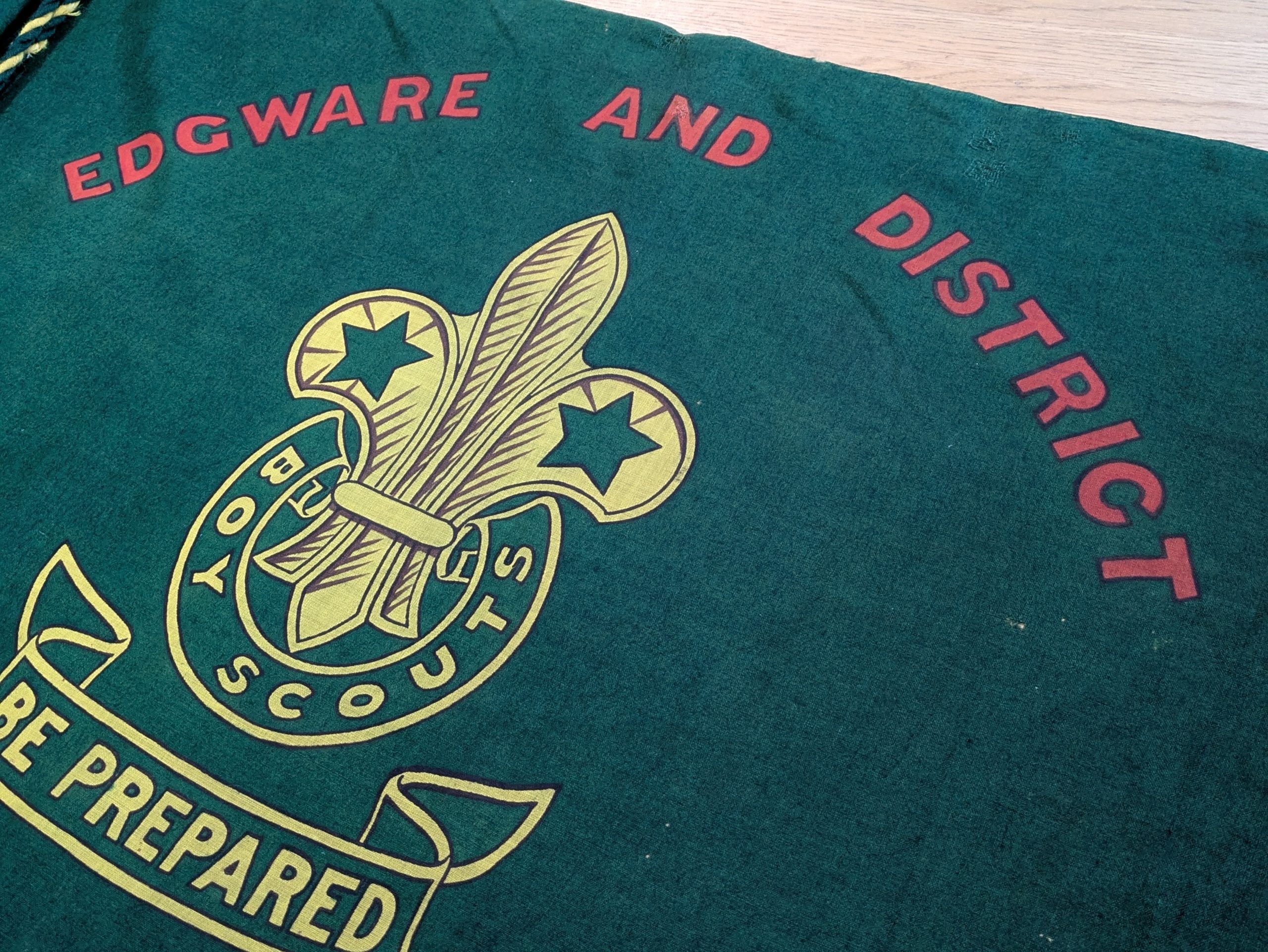
Edgware and District flag

District Sports Day, early 1960s
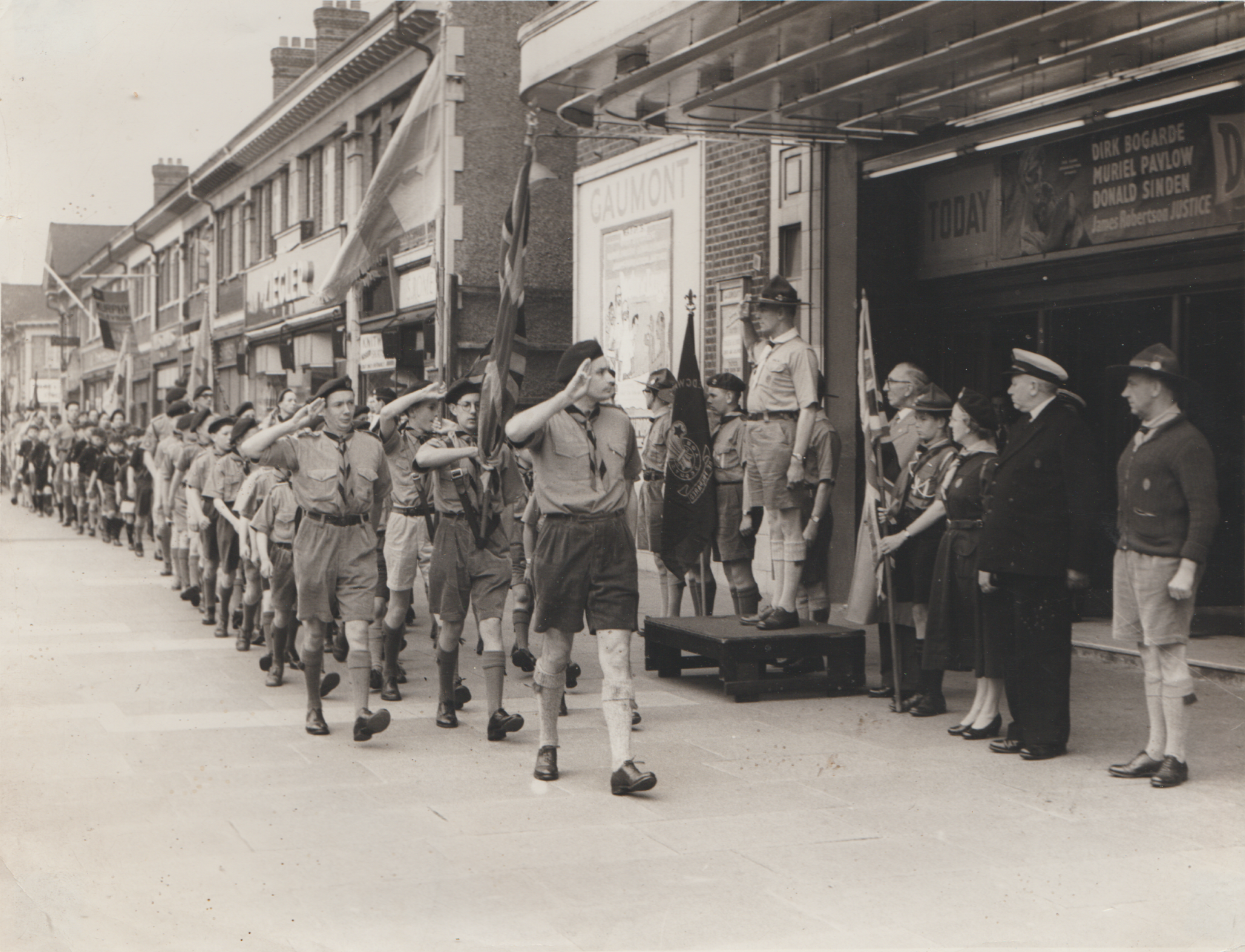
St George’s Day parade 1957, at Burnt Oak Cinema
Pear Wood
Pear Wood, off Wood Lane in Stanmore, was the District campsite for many years. Dating the campsites origin is an ongoing task, however our best guess comes from this June 1939 District Bulletin: “arrangements have been made with the Steward of the Camping Club’s Camp Site at Grimm’s Dyke, Harrow Weald for the exclusive use of one of their fields for the Edgware and District Boy Scout Association on the last week-end in each month”. Grim’s Dyke crosses through Pear Wood, so it is possible this text refers to the site. It also coincides with the demise of the camping site at Bentley Priory (a six minute drive away), as foreshadowed in the subsequent article: “the old site that the R.A.F. have so kindly allowed us to use for several years past will not be available this year.” With the onset of the Second World War, this author estimates the RAF would not be leasing Bentley Priory again for some time.
In 1956 Kenton Local Association kindly invited the District to share the running of Pear Wood. In its first year shared, there were a total of 817 camper nights (Edgware) recorded.
Looking at the site itself; one former Scout who regularly camped there recalls ‘facilities were few – there was a standpipe on the border of the Scout and Guide fields, and a small hut with no electricity, gas or water laid on. Latrines had to be dug. But despite it being only a short distance from the A41 it was wonderfully isolated and you could be a hundred miles away from Edgware.’ Before water was supplied to the site, campers had a long haul to and from Wood Farm for water. It was then in 1960 that volunteers then laid 800 feet of pipe, dug with picks and shovels. Facilities improved again in 1962/3, with the Charles Marmoy Memorial Hut (in memory of the 13th Edgware GSM), providing ‘ample accommodation for indoor courses’.
The site was the location for the annual camping competition, with Scouts competing for the Harrow Flag – named after it was presented to the District when they broke away from the Harrow administration in 1930.
After Edgware District was absorbed in 1965, Pear Wood continued to be used for many years, lastly ending up as the District Campsite of Pinner & Headstone. Today footpaths to connect it into the larger Stanmore Country Park. Although it is still listed online as available for camping, the author suspects local groups use it more for day events and hikes now.

Scouts camping at Pear Wood, 1961

July 1961 Cubs Open Day, singing around the fire
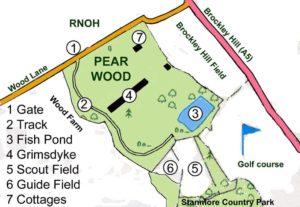
A map of the site, courtesy of Harrow Scouts
Scouting in Edgware today
Since the boundary changes in 1965, Edgware-named Groups have been split between two Districts. This makes researching the next chapter of history somewhat more difficult. What we do know is the ten Edgware Groups in 1965 became six Groups by 2005. This was very much in trend in a national decline in Scouting around the 1990s. With this reduction in Groups, the new Districts themselves aforementioned eventually merged with neighbours to cover larger areas.
At the time of writing (2025) there are six Edgware Groups still active; three in Harrow District and three in Barnet District (or seven Groups if you consider the 1st/6th merged).
In consideration to other areas, Edgware remains a strong place for Scouting. And with UK Scouting bouncing back with significant growth and an increase in housing developments in the area, we could start to see a parallels to Edgware 100 years ago. Perhaps it will be time to re-open some of those former groups…
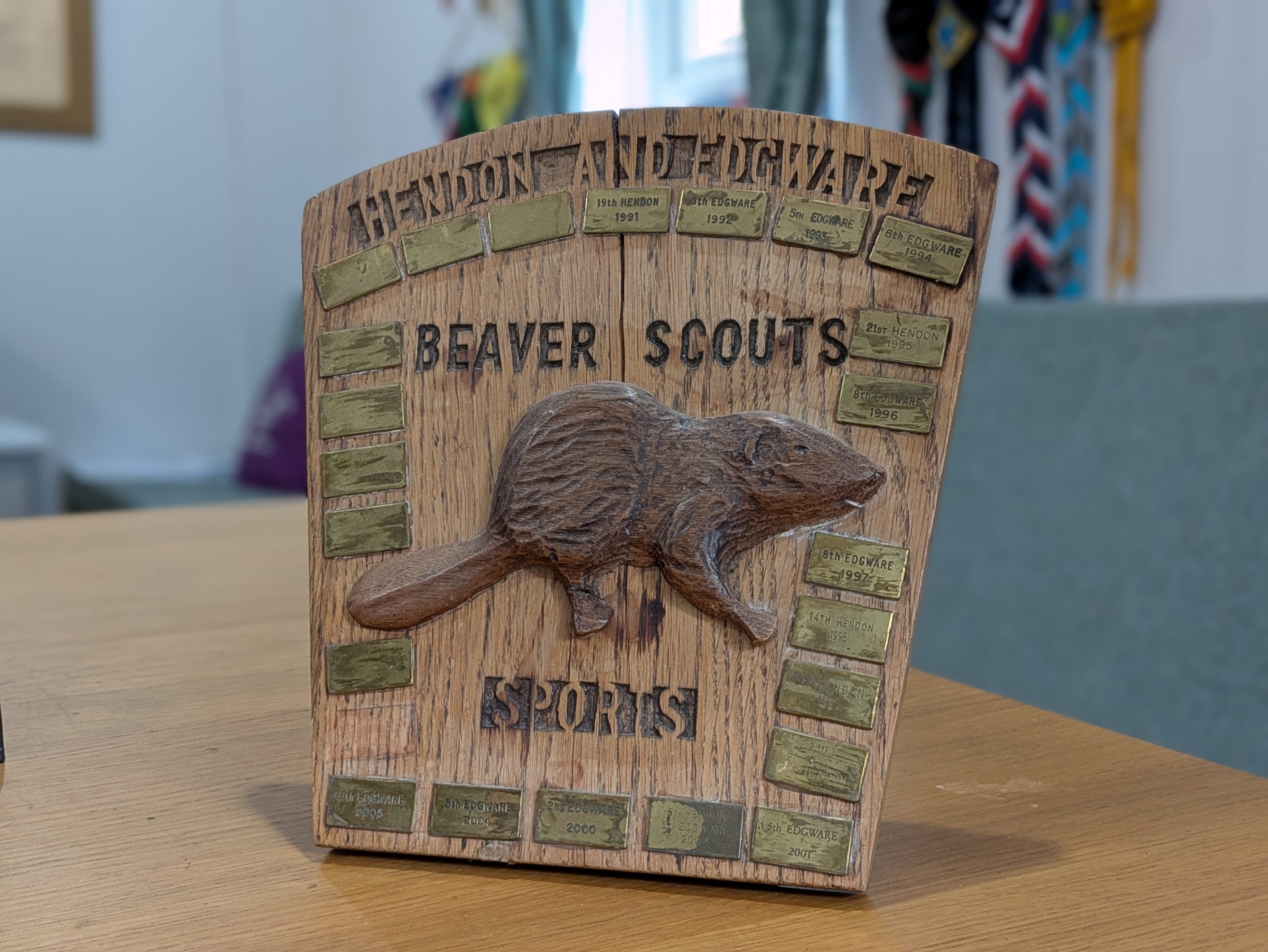
Hendon & Edgware Beaver Sports trophy 1991-2006

Edgware Groups at the Remembrance Sunday service (2023)
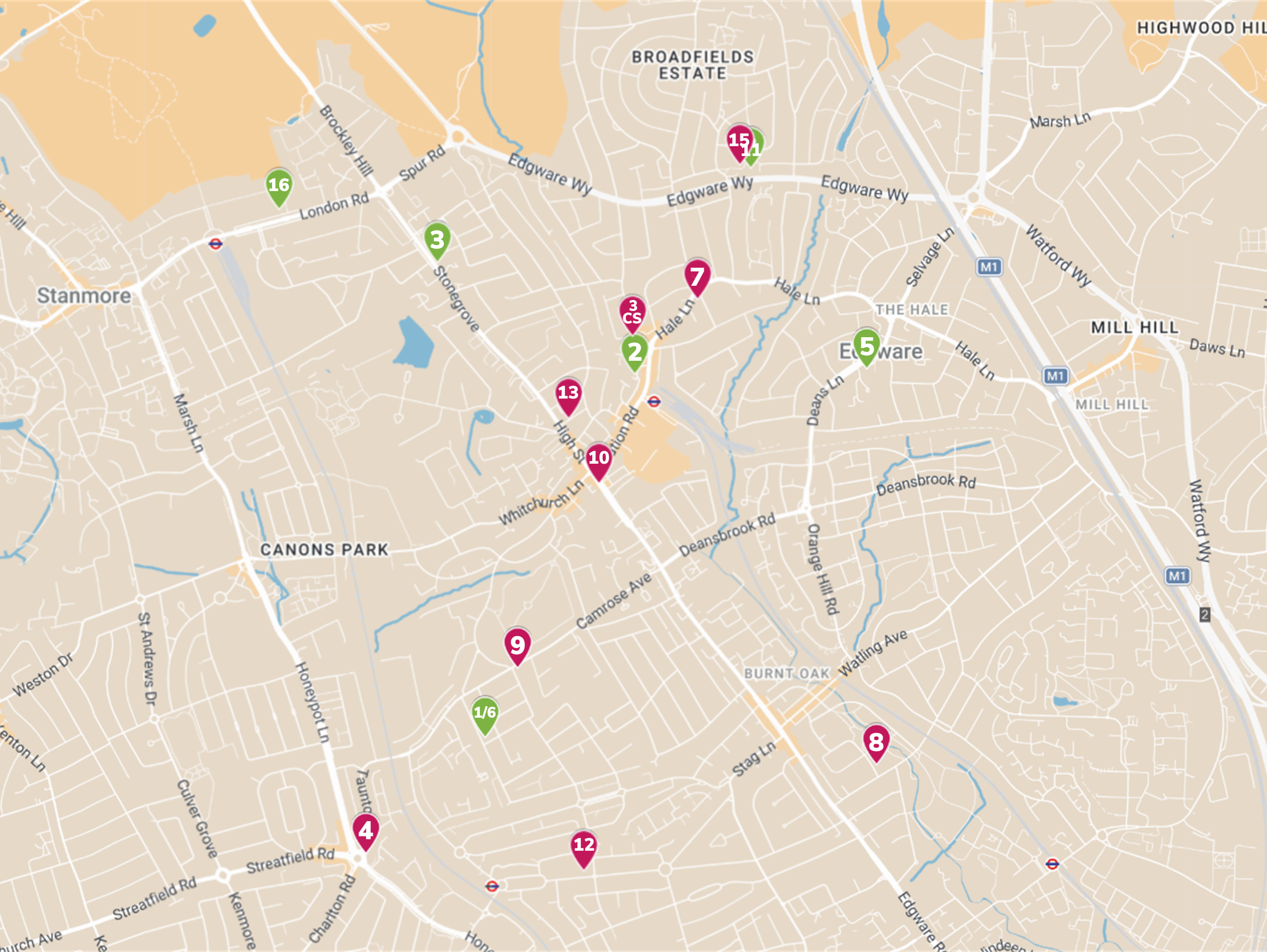
A map of Scouting in Edgware, matching the table at the top of the page
+
District badges
The District badges that Edgware groups were spread across in 1965 and their meanings:

Kenton & Kingsbury: The Middlesex coat of arms refers to the fact these Boroughs were once part of the County, whilst Tower Bridge in the background nods to the new Greater London County.
Hendon & Edgware: The Knights of St John of Jerusalem used to own land in Hendon, hundreds of years ago. The lamb and flag was their badge. The lamb stands on a hill, as a reminder that Hendon was originally a village built on a hill, and in Anglo Saxon times was called Heandune – meaning “high hill” or “high down.” The airscrews, from the crest of the Borough of Hendon, and the wings refer to the former borough’s links with aviation. This badge was introduced in 1978.
Stanmore: The Stanmore Obelisk, erected at the top of Brockley Hill in 1750, commemorates a battle in which the British tribes united to defeat the Roman Legions during Julius Caesar’s second invasion.
+
Edgware Group histories
1st Edgware
You can read a full account of their history at Hounslow Libraries.
2nd Edgware
That’s us! You can explore our Group History over here.
3rd Edgware (Camford School)
In 1931 a third Group began, attached to Camford School. The school itself (for boys of 7 to 16 years) was addressed at 22 Edgwarebury Lane, with a girls school of the same name was a two minute walk away at 294 Hale Lane. Both have since long been demolished.
Early records reveal for a time the Group met at the 2nd Edgware Scout Hut, and that George Rust was Scoutmaster at the Group.
The earliest District census we have is from 1943 and lists the Group as ‘dormant’; by 1944 it is not listed at all.
This Group is of no relation to the current 3rd Edgware, who are listed further below.
4th Edgware
The 4th Edgware were founded by Cecil Brown in October 1932, attached to St Lawrence’s Church on Whitchurch Lane. In their early years, the Group gained the name of ‘Diggers’ from the Group Colours which commemorate the work of the Rev. Digby.
They first met in the two rooms above the rectory stables, before getting their own headquarters. Sadly, this hut (and all their equipment) was destroyed by fire. After a stint at St Lawrence’s Small Hall, they obtained a new Hut on Honeypot Lane in Stanmore in the 1950s. After many vicissitudes in these early years, the Group found a path forwards to operate for over 60 years.
The Charity Commission website removed the Group from their listings on 5th October 1993, reasoning they ceased to exist.
5th Edgware (John Keble)
The 5th Edgware (John Keble) opened on 1st July 1933, sponsored by the Church on Deans Lane. They continue to operate there today.
The Group were originally part of the London Diocesan Boy Scouts Association, before transferring to Edgware And District in 1939. A District article from 1951 describes the Group “has always been sound and healthy and has had many excellent and good Cubs and Scouts pass through their hands into the world with noteworthy results”. The same article mentions their scarves as ‘light blue’, meaning their current blue with white came later.
6th Edgware
There is a detailed history of the 6th Edgware which you can read on their website here.
7th Edgware (St James’)
Edgware’s shortest-lived Scout Group. On 5th February 1935, the first seven members of the Cub Pack were enrolled. The Group were sponsored by St James Presbyterian Church (265 Hale Lane, today home to Edgware Adath Yisroel Congregation Synagogue) and met at their church hall on Tuesdays at 7pm.
Their next mention in the District Bulletin is in November 1936, announcing their closure. With the resignation of Cubmaster Ivy Mount, the church governing body took the opportunity to run Boys Brigade and Life Boys instead.
8th Edgware
In November/December 1937, 8th Edgware Scouts opened, meeting at the Methodist Church Hall on Garrett Road. Their founding members include Scoutmaster D.M. Taylor, Cubmaster Miss Thom and Assistant Cubmaster R. Cooke.
By the time the Group closed in 2012, they were meeting at St Alphage Church on Montrose Avenue. Their remaining members joined 2nd Edgware Scouts.
9th Edgware (Camrose Baptist)
At the same time in 1937, the 9th opened at Camrose Baptist Church, under W.H. Spreadbury as Group Scout Master. Our earliest District census in 1943 does not list the Group.
10th Edgware (St Anthony’s RC)
The 10th registered in Autumn 1938 as St Anthony’s. They met adjacent to Edgware Motor Co’s premises on the High Street (A5).
In the 1943 census they have 49 members in the Group. The following year they are listed as ‘disbanded for duration war’ whilst their Scoutmaster served in the forces. The same footnote appears in 1945 and 46, before the Group ceases to be mentioned. The 10th were part of a trend of Groups across the country closing during the Second World War, simply due to their leaders being called up for military service.
11th Edgware
The 11th Edgware were registered in November 1938. They started with 18 Cubs and 18 Scouts, under the sponsorship of Edgware United Synagogue (formerly Edgware District Synagogue of Mowbray Road). They were the first Synagogue-sponsored Group in Edgware, following the growth of the areas Jewish population.
Their first Group Scoutmaster was Mr S. A. Domb – a position he also held at the 33rd Stepney Scouts. The 11th Edgware held their official opening on the 15th January 1939 in the Synagogue Hall. Here, the Rev Amias made his Promise and was invested as Chaplain of the Group. By 1958 the Group was so large, housing two cub packs and two scout troops, that a second breakaway group was started at Stanmore Synagogue – the 16th Edgware.
In August 2009, a newspaper article announces the Group was re-opening in September after a 20 year gap, an operation headed by Andrew Donn. In this reopening, the Group added a red stripe to their previously plain light blue scarves.
12th Edgware (Queensbury Methodist)
August 1941 welcomed the 12th Edgware, who met at Queensbury Methodist Church on Beverley Drive. Their black scarf (with a red triangle) was a prominent choice when they opened. With the context of the Second World War, it also meant no clothing coupons were required and the Group earned the nickname “The Black-Out Boys”. Despite the difficulties opening in wartime, sections met regularly. Camping was done in hike tents (two to a tent) as new equipment was hard to come by. The Group closed sometime after the 1964 census.
One notable member of the Group was singer-songwriter George Michaels, under the guidance of scout leader Jack London.
13th Edgware
In October 1942, the 13th opened. Within a year, they had 15 Cubs and 12 Scouts listed, before temporarily closing in 1944-45. The Group was “reborn” in 1948.
They met at Edgware Congregational Church Hall on Grove Road, just off Stonegrove; the same church of which they were sponsored by. At some point, their Royal Blue scarves changed to Emerald Green and scarlet.
14th Edgware (Air Scouts)
The 14th Edgware opened in 1944 to run Air Scouts. This specialised section of Scouting launched nationally three years earlier, intended as a means of feeding the newly formed Air Training Corps.
In 1944 they had 36 Air Scouts, with the following years totalling 22, 15, then 8. By 1949 (and possibly 1948) the Group no longer appears on the census, supposedly folding due to low numbers with a post-war decline in Air Scouting.
15th Edgware
This Group’s history dates back to 1941, when, with 60 Cubs on the books (and a waiting list!) 2nd Edgware had to open a second Cub Pack. The ‘B’ Pack drew mostly from the Broadfields area, although whether it was meeting at Rectory Lane or at St Andrew’s at this point is not clear (there is a reference in September to a new St Andrew’s Troop ‘which is to be started’). As this Pack – and then Troop – continued to grow, it was decided to form a new Group at St Andrew’s. This was the ‘daughter church’ to St. Margaret’s (2nd Edgware’s sponsor) built in the middle of the Broadfields Estate, whilst the early 15th were considered a ‘sister group’ to 2nd.
In early 1947, the 15th Edgware (St. Andrew’s) came into being, under the capable hands of Mr John Rowe, GSM. Within four years they too were running two Cub Packs. In this time their royal blue and black scarves were also changed to black and green.
At one point they moved from the hall adjacent to the church, to their own hut next to Edgware United Synagogue. One member recalls leaders and parents built this, which was named the Thorne Hall. The hall is still used by the synagogue today.
The Charity Commission website removed the Group on 9th October 2003, reasoning they ceased to exist.
16th Edgware
You can the Group history on their website here.
In addition, we can add the Group’s colours were dedicated on 5th January 1958, at a ceremony attended by the Mayor and Mayoress of Hendon, as well as the DC. The Group initially wore a blue scarf with a white border, before switching to today’s green.
3rd Edgware
In 1969 a new Group opened in Edgware – filling in the first missing number, rather than continuing up to 17. They opened on 3rd February that year, and continue to operate today at Edgware and Hendon Reform Synagogue, on Stonegrove.
1st/6th Edgware
In 2000, the 1st and 6th Edgware merged. More can be found on the 6th history page.
+
Further Edgware & District history
Inaugural year
The birth of the Association is graphically described by R.F. (John) Thurman in his foreword for the Official Handbook of the Association’s 21st Birthday. Most of his foreword is repeated here (word for word because it cannot be bettered!)
“Back in the summer of 1929, when I first became associated with the 1st Edgware Group, we were part of the Harrow Local Association and the 1st. Edgware Group was always referred to by the District Commissioner, J.B.Malthouse, as ‘our northernmost member’. In those days there was very little transport from Edgware to Harrow and to go to a Scouters’ meeting entailed quite a considerable journey which took a long time, but we managed to get across there. Edgware of course was rapidly changing from a country village into an enormous suburb and the 1st Edgware Group, which had been sufficient for all Scouting needs for many years, was obviously not going to be enough to cope with the changing picture of the place.
The D.C. of Harrow, in his wisdom, first of all appointed a District Scoutmaster for the four Groups on the northern fringe of the District and Kim Durward was the obvious man to take on the job. I can remember so well our first meeting in the Stanmore Institute. There were representatives from the four Groups, 1st. Edgware, 1st. Stanmore, 1st. Harrow Weald and the 1st. Brockley Hill. I can still see the picture of Commissioner Malthouse, most immaculately dressed in black coat and vest and striped trousers, with one foot on a chair and his chin cupped in his hand. He talked to us at considerable length but never for a moment lost our interest. He talked about his hopes that within a short period we should, through our own efforts, earn the right to become a District of our own. He said Harrow did not want to get rid of us and he thought we did not want to leave Harrow but obviously, with the tremendous growth that was taking place, Harrow Association, however excellent, just would not be able to cope. The Stanmore Institute, incidentally, was to prove the place of many of those early meetings, rallies and camp fires which we all enjoyed so much. I remember a concert when nearly all performers the had flu, and also a fantastic afternoon with the Cubs when the Tug-of-War ended with the winning team on the far side of the road with their backs in the hedge and the losers hanging on to doors, window- frames and railings in an effort to hold back.
During the trial year of 1929 and early in 1930 the four original Groups were expanding, getting to know each other and, I think it is fair to claim, putting up a pretty high standard of Scouting. New groups were being formed or arrangements made for their fairly early formation and there came the moment where the Commissioner for Harrow was satisfied that we could stand on our own feet and Kim Durward was appointed District Commissioner. I can well remember Hubert Martin, our well-loved County Commissioner coming to St. Lawrence’s Hall in Edgware to present the Warrant to the District Commissioner. It was a wet evening and the hall was completely crowded, I can also remember that my Troop the 1st Edgware, erected a flag pole and we were ambitious and made it so large that it somewhat originally remained at an angle of forty-five degrees!! As though it were only yesterday I can remember Hubert Martin, as he handed over the Warrant, saying, “I am sure you have the right man as Commissioner but that in itself is not enough, no leader can succeed unless his followers are loyal and determined to help him”. That, of course, in a nutshell, is the recipe for successful Scouting in any District.
Amongst my memories, also, is the recollection of a most incredibly dull meeting held in the old Institute in Whitchurch Lane, Edgware, which has long since been demolished and been replaced by the Police Station. There we had to go through the bye-laws and I think, as a young Scouter, it was about the first time I had come up against administration and all its potential horrors. What a remarkably dull meeting this was. The old building was a most depressing place and I do not think we really knew what we were supposed to be doing, but it was an important occasion in that this was the moment when the Edgware Association approved its bye-laws and was able to become official”.
List of Groups
Below are a complete list of Groups who were members of Edgware and District:
- 1st Brockley Hill (Royal National Orthopaedic Hospital)
- 2nd Brockley Hill
- 1st Edgware (The Herons)
- 2nd Edgware (St Margaret’s)
- 3rd Edgware (Camford School)
- 4th Edgware (St Lawrence’s)
- 5th Edgware (John Keble)
- 6th Edgware (1st Queensbury All Saints)
- 7th Edgware (St James’)
- 8th Edgware
- 9th Edgware (Camrose Baptist)
- 10th Edgware (St Anthony’s RC)
- 11th Edgware
- 12th Edgware
- 13th Edgware
- 14th Edgware (Air Scouts)
- 15th Edgware (St Andrew’s)
- 16th Edgware
- 1st Harrow Weald (All Saints)
- 2nd Harrow Weald
- 3rd Harrow Weald (St Michael & All Angels)
- 4th Harrow Weald (St. Anselms)
- 1st Kingsbury (Holy Innocents)
- 2nd Kingsbury (Chandos)
- 3rd Kingsbury (SS. Sebastian & Pancras)
- 4th Kingsbury (Springfield)
- 1st Stanmore
- 2nd Stanmore
- 3rd Stanmore
- 4th Stanmore
- 4th Stanmore
- 5th Stanmore
- 6th Stanmore
- 7th Stanmore (St William of York)
Trophies, cups and shields
Over its 35 years, there were a number of competition prizes highly sought after. Below is a list of the names we have found.
| Name | Event |
|---|---|
| The Harrow Flag | Camping Competition |
| Senior Scout Camping Trophy | Camping Competition |
| Durward Trophy | Cubs Handicraft |
| Chandos Trophy | Scouts Handicraft |
| Dale Trophy | Senior Scouts Handicraft |
| Grey Wolf Trophy | Cubs Singing |
| Arridge Trophy | Scouts Expedition |
| Springfield Cup | Sports Day |
| Scout Pennant | Sports Day |
| Cub Pennant | Sports Day |
| Geoffery Spencer Cup | Sports Day |
| Steer Cup | Sports Day |
| Mile Cup | Sports Day |
| Sylvia Marchant Cup | Swimming Gala |
| Marchant Cub Shield | Swimming Gala |
| Marchant Scout Shield | Swimming Gala |
| President’s Shield | Swimming Gala – Senior Scouts |
| Leslie Raymond Trophy | Swimming Gala – Rovers & Scouters |
| Group Trophy | Swimming Gala |
| District Trophy | Swimming Gala – Scouts under 15 relay |
| Scouts Flitch | Various skills (1933-64) |
| Cubs Flitch | Various skills (1945-64) |
| Stone Trophy | All round Group points |
| Cub Trophy | TBC |
1st Brockley Hill
1st Brockley Hill met at the Royal National Orthopaedic Hospital and ran Scouting for long-term patients at the hospital. According to a District booklet: “the 1st Brockley Hill were registered in 1925 [or 28?] when a number of Rovers from the immediate neighbourhood, passing through the hospital grounds during a hike, observed the little chaps, and this gave them food for thought. They asked and received permission to visit boys of Cub and Scout age in the various wards on Sunday mornings to organise Scouting activities. This attracted the attention of one of the medical staff, Dr. Durward (Kim)”. Durward was an anaesthetist at the hospital and later District Scoutmaster.
The text continues: “In 1928, Rovers of the old Harrow District Association organised a rota. One of these Rovers became the S.M. and still holds the rank.” Other early names include two future 2nd Edgware leaders; Alfred Martin was Rover Leader and Edith Moss was Cubmaster at 1st Brockley Hill.
“In 1935, the opening of a convalescent home in the grounds permitted some of the boys to do open air work and a camp was held in 1936.” The Group wore yellow scarves and were keen to get involved in many District activities. At present we don’t know when the Group closed.
2nd Brockley Hill
For some time there was a 2nd Brockley Hill Group. Application was made in November 1936, in connection with the Stanmore Cripples’ Training College, which was in conjunction with the RNOH. Dr Durward appears instrumental again, as GSM. The Group was actually a re-registration of the 58th Kensington (Kensington Cripple Boys’ Home, Wright’s Lane) which had closed down.
In the 1943 census, the Group (along with the 3rd Edgware, 9th Edgware and 4th Stanmore) are recorded in the census footnotes as not being included in the total number of Groups. Presumably, the Groups have recently closed. However, in 1947 they re-appear with 8 Scouts enrolled; the same total as 1949. By 1955 they have closed.
Further history
Well done for making it this far! For even further history and photos, we have composed this document here.
Bulletin snapshots

Edgware And District Harrow Flag Competition 1934 rules


Monthly Bulletin, April 1935

March 1935

January 1939, inc. the first year of the 9th Edgware

January 1939 continued

September 1938

November 1936

February 1935

November 1936 – Edgware’s shortest lived Group.

Edgware And District BSA monthly bulletin December 1937

Edgware And District BSA monthly bulletin October 1938